Data and tools
to invest with confidence
in training and AI

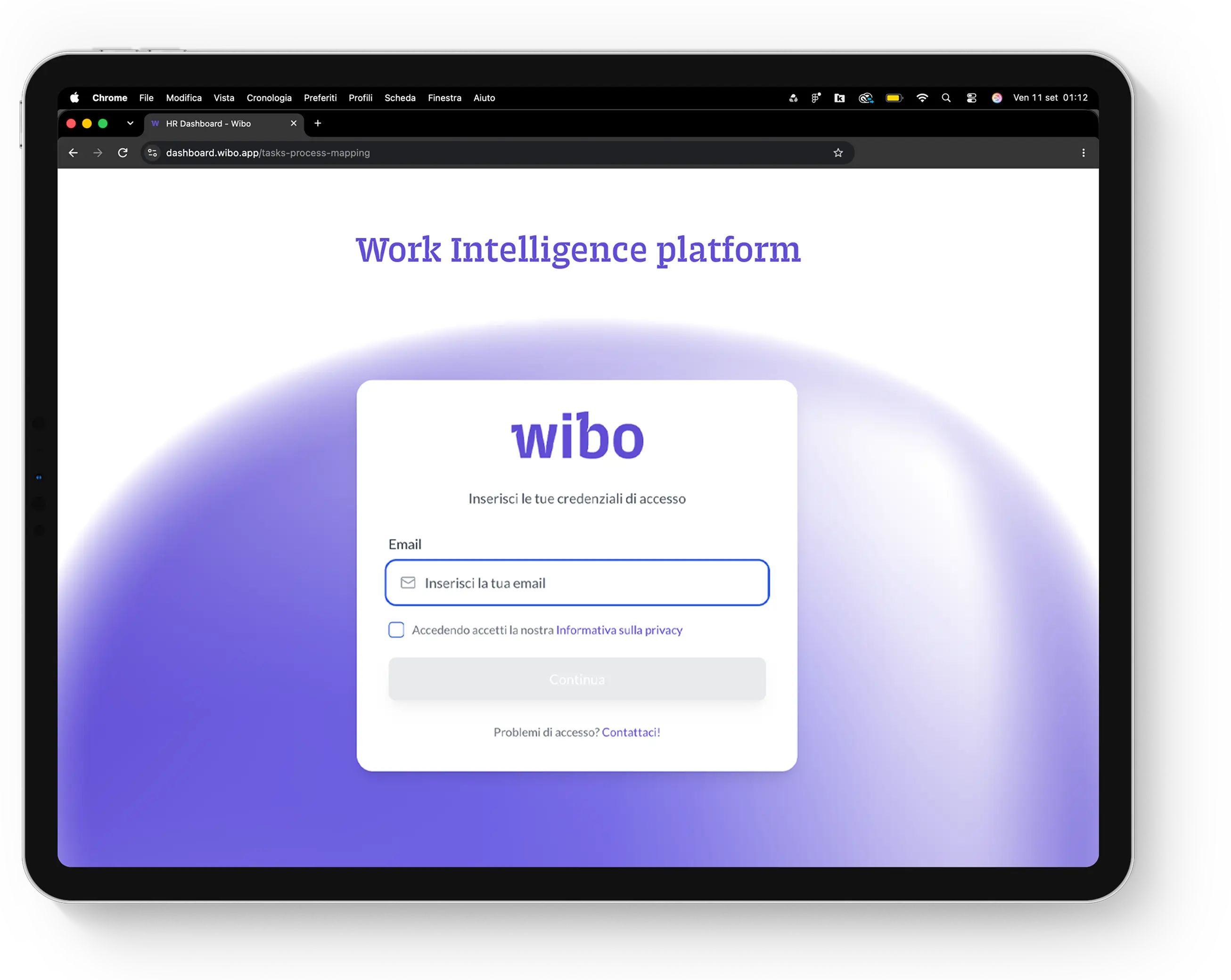
We interview people across your company, analyze how work really happens, and map it on an interactive dashboard. Get measurable data on tasks, behaviors, skills, and the priorities worth acting on.

Get in touch
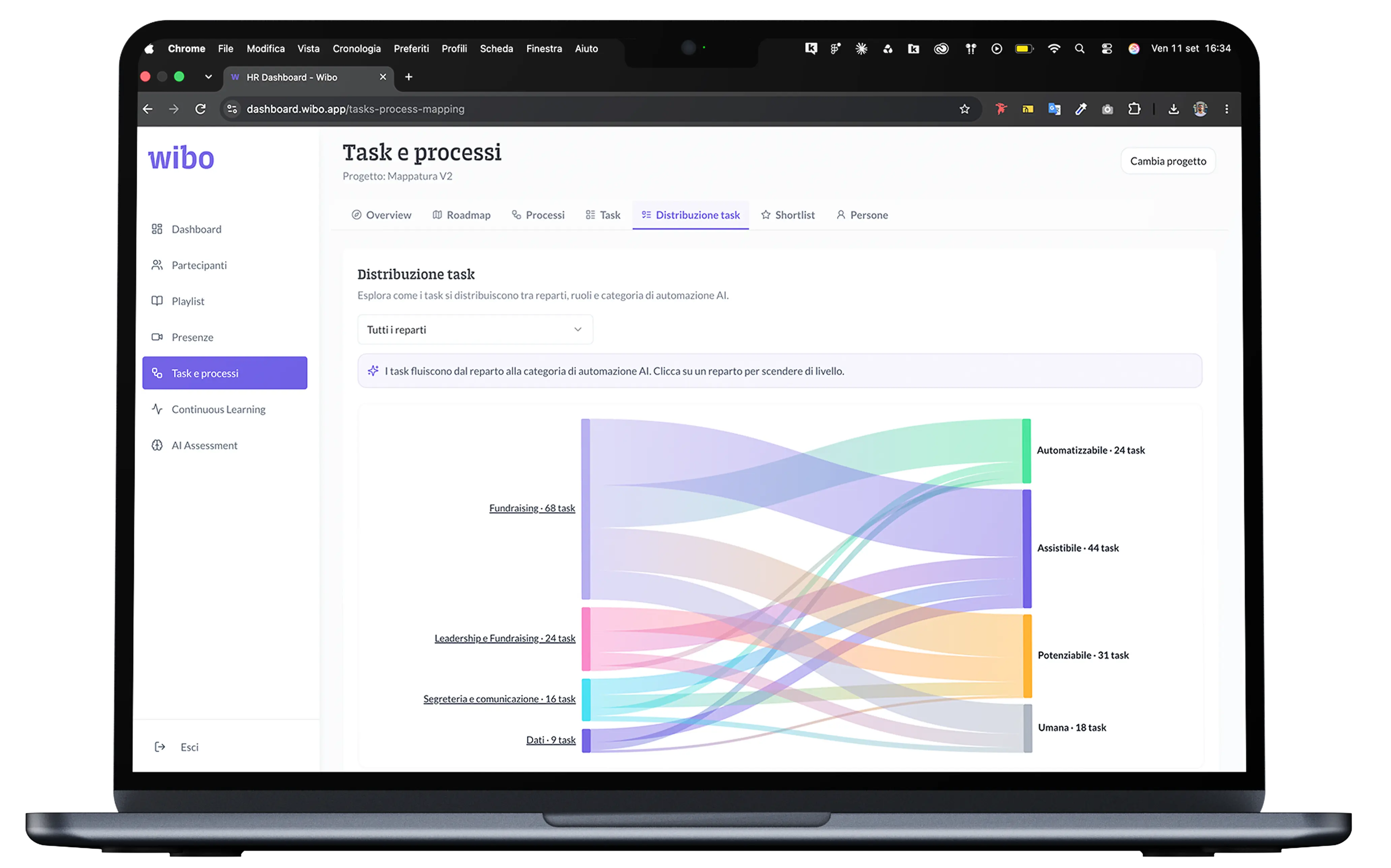
Task distribution by AI automation category · Wibo
AI

We draw a map of the work
inside your company: where it costs time,
where it creates value, and how to evolve it

Work Intelligence maps behaviors and processes through the stories of the people who live them every day.

We can interview up to 2,000 people a week, turning it into an aggregate view of how work actually unfolds.

We cross-reference the feedback and information we gather to spot which processes to simplify, which skills to build, and where AI can create value, freeing up people's human potential.

A new perspective, for working better

A unique vantage point, with a full view of work, people, and technology

AI

Every organization
is the result of the work
of its two intelligences:
the human one and the artificial one

Today these intelligences are often analyzed and managed in silos, by functions with different priorities.

Work Intelligence identifies existing and potential connections, bringing HR, IT, and the Leadership Team to the same table — because transformation only works when it becomes a shared project.

The goal is simple: make the organization smarter, by getting its intelligences to work together.

A shared picture
for HR, IT, and the Leadership Team

And all the data you need to invest systematically in training, people, and AI.

Work

Tasks, time, handoffs, bottlenecks, processes that don't create value, and concrete opportunities for AI.

People

Skills available and skills to build, organizational wellbeing, friction points, and perception of AI.

Technology

Tools already in use, real adoption, and room for AI agents or redesigned processes.

Measurable data and an interactive dashboard
for whoever is leading the transformation:
HR, IT, and the Leadership Team

The Work Intelligence platform

Inside Work Intelligence: from processes to priorities

The platform ranks processes by the most useful lever — automation, soft skills, redesign, or protecting human value — making it clear how to move from how you work today to how you could work, with a concrete action plan.

Get in touch

How we turn listening into a concrete plan

Here's what real work looks like, read across dimensions that shape one another.

01We listen to the team
Through an interactive voice chat, our colleague/agent Daniel gets each person to walk through the work they do: activities, tools, time, and handoffs with other teams. And most importantly, what kind of support they feel they need to work better. He also gathers the skills they use and need to build, what energizes or drains them, and how AI is perceived and used.
02We analyze work, behaviors, and technology
We weave every voice into a single, living picture: tasks and processes, skills, organizational wellbeing, friction points, and perception of AI. We surface where work gets stuck, where people need to build new skills, and where technology and AI agents can create value.
03We design processes, training, and AI agents
With the full picture in front of them, leadership, HR, and IT decide together which processes to redesign, which skills to train, and where to introduce AI. Every opportunity comes with an expected impact and a priority — starting from the real needs, tools, and skills already inside the company.
04We turn the plan into action
The plan becomes concrete: what to do, in what order, and with which resources. Training paths on human skills and AI skills, AI agents, pilots, and redesigned processes become part of everyday work. The value isn't in the report — it's in what changes on Monday morning.
05We measure results and iterate
Through an always-on dashboard, we track implementation and measure over time how processes, skills, wellbeing, and AI adoption change. The results feed the next cycle of transformation.

Skills, wellbeing, and transformation: practical tools

For HR, IT, and the Leadership Team

Aggregate dashboard | data and tools to lead the transformation

The dashboard lets you see data on organizational wellbeing and human skills. Then, workflows, AI adoption data, and a section dedicated to training opportunities. Finally, process analysis and the evaluation of potential AI solutions. The shortlist ranks opportunities by impact, current burden, and technical feasibility.

Watch the full demo
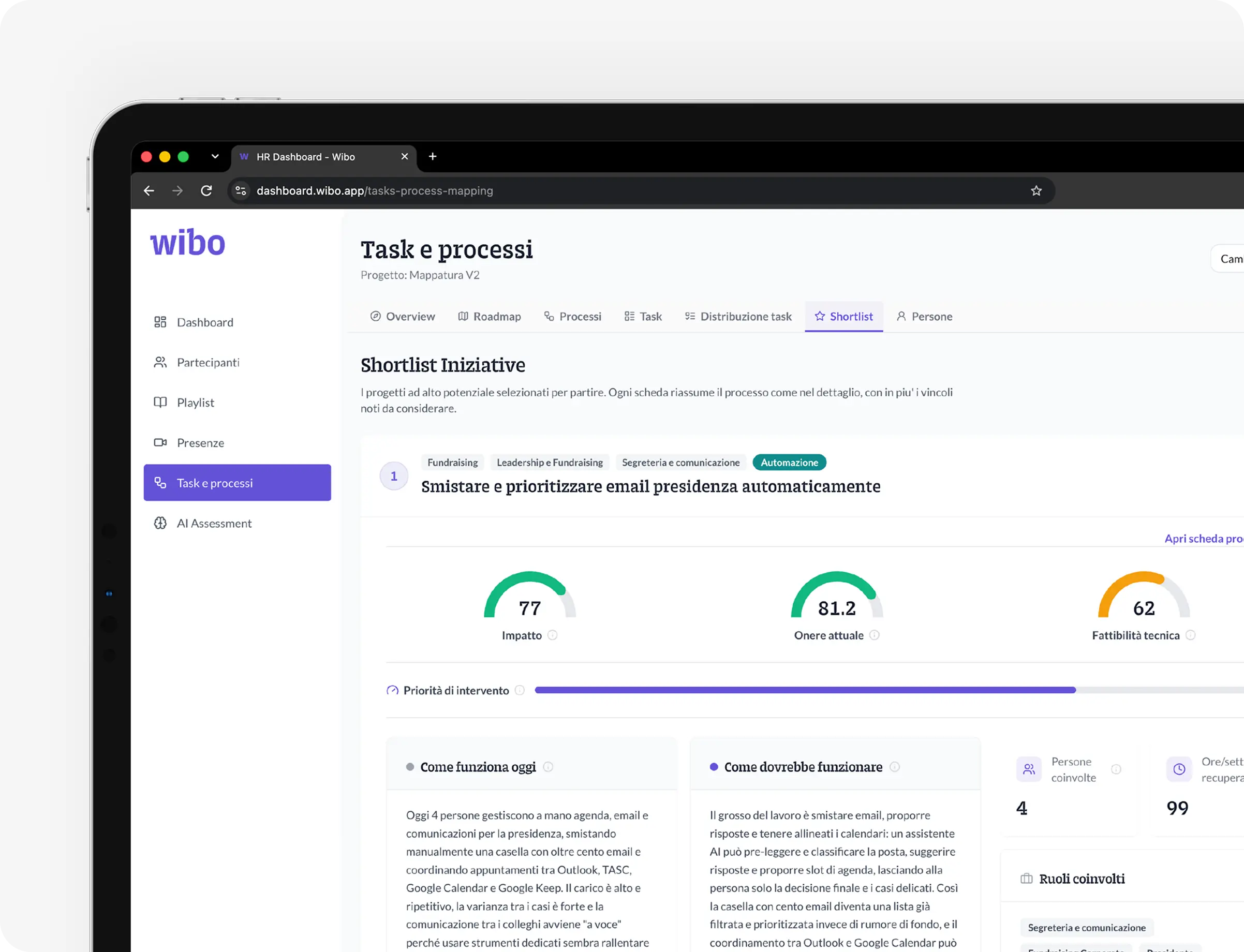
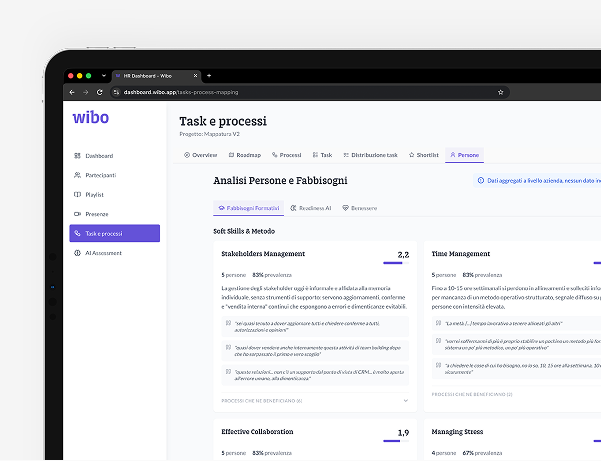
Aggregate dashboard · Wibo
Individual reports · Wibo

For the people we interview

Individual reports | and continuous training programs

A recap of a typical week, skills used and skills to build, wellbeing signals and perception of AI, concrete opportunities, and a personalized training path, with follow-up on progress.

Open a sample report

It starts with people, and comes back to people

Starts from real work
and actual behaviors

We start from people's direct account of what they do every week and how work really happens — not from abstract competency models.

Designs
targeted interventions

From real problems, we design simpler processes, focused skill-building paths, and AI agents that step in only where they create value.

Delivers measurable results
across the whole company

People take part first-hand and receive their own report. Leadership, HR, and IT work with different roles, but starting from the same data.

Data and
ground rules

Data is processed in aggregate form, and used to read how work happens and guide processes, training, and upskilling. It can never be used for individual performance reviews, disciplinary action, or personnel decisions.

AI

AI changes tasks and processes. Skills and the organization evolve together.

AI on its own, used without context, doesn't get you far. To use it well, you first need to understand which activities absorb time, which create value, and which can be automated, supported, or rethought.

This reading surfaces the processes worth redesigning and the skills teams will need. According to MIT, 95% of corporate AI projects in 2025 failed to produce impact because they focused only on the technology, without starting from a specific problem and the organizational context.

Work Intelligence connects processes, skills, wellbeing, and technology. That way, leadership, HR, and IT choose together where to act — with training, AI agents, or redesigned processes — and can measure the effects over time.


Ongoing projects with companies that are transforming

Askoll Contè Scarpe e Moda Esprinet Sipec Philip Morris

The diagnosis is the starting point.
The platform guides the transformation.

The Work Intelligence Platform is Wibo's suite connecting work diagnosis, training, and AI agents. It starts from tasks, processes, and behaviors, translates evidence into interventions, and tracks their effects to guide the organization's transformation over time.
01

Work Intelligence and diagnosis

We map tasks, processes, and behaviors; we read skills, wellbeing, and perception of AI; we point out where to act.

02

Training

We build learning paths around the skills that emerge from real behaviors and real work, and measure their effects.

03

AI agents & processes

We redesign processes and bring in AI agents only where they create value, monitoring adoption and results.

From diagnosis to training: a systemic, continuous approach.

The evidence from Work Intelligence becomes interventions people can actually see: targeted playlists, class notes, recordings, books, SCORM modules, and conversational exercises with AI. Completions and progress feed the measurement, so transformation doesn't stop at the report.

Get in touch
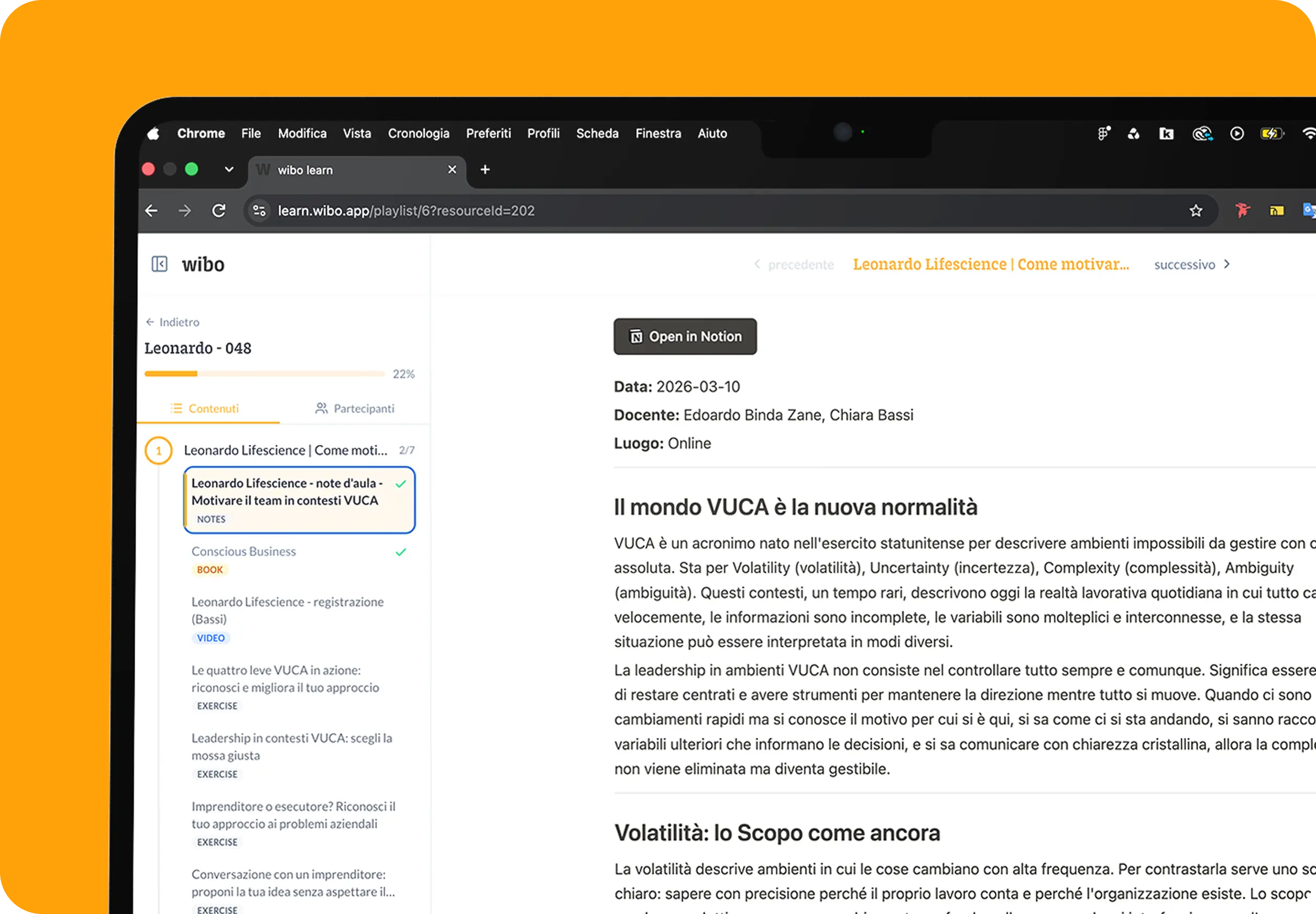
Wibo Learn training platform

FAQ

What is Work Intelligence, and how does it fit into the Work Intelligence Platform?
Work Intelligence is the diagnosis of real work: it maps tasks, processes, and behaviors, and reads, alongside them, skills, organizational wellbeing, and perception of AI. The Work Intelligence Platform is the broader suite that starts from this diagnosis to build training and AI agents, guide implementation, and measure its effects over time.
How do you go from the diagnosis of Work Intelligence to action?
A traditional assessment compares skills against a theoretical model. Work Intelligence also analyzes skills, but observes them within the context of real work: tasks, processes, tools, wellbeing, and perception of AI. The result isn't an abstract grid, but a shared map showing where to redesign processes, where to train, and where to introduce AI agents.
What's the difference between Work Intelligence and a skills assessment?
Work Intelligence observes skills inside real work, not in the abstract: it cross-references them with tasks, processes, tools, wellbeing, and perception of AI. The result isn't a grid of proficiency levels, but a shared map showing where to redesign processes, where to train, and where to introduce AI agents.
Is Work Intelligence only useful for AI projects?
No. AI is one of the levers of transformation, not the only goal. Work Intelligence surfaces problems and opportunities in tasks, processes, skills, and wellbeing; then leadership, HR, and IT decide together whether to act through training, AI agents, redesigned processes, or a combination of all three levers.
How do you get honest answers?
Answers are honest because conversations are one-on-one and what comes back to the company is always aggregated: no one risks anything by being truthful. Wibo doesn't ask for judgments about managers or colleagues, but a concrete account of activities and how work actually happens, cross-referencing many voices. Real friction points emerge from recurring patterns, not from any single answer.
Does Work Intelligence respect employee privacy?
Yes. Conversations are one-on-one, but what comes back to the company is always aggregated: data is never used for individual performance reviews, disciplinary action, or personnel decisions. Scope and purpose are declared and put in writing before starting, and people know exactly how their data is handled.
How much time does it take?
The first snapshot on a pilot department is ready in about two weeks. Listening is handled by Wibo's agent, so your team doesn't have to interview anyone — you just need to define scope and internal communication together, and give access to the people involved.
Can it be funded through joint interprofessional funds?
Often, yes: since it's a training program, it frequently qualifies under joint interprofessional funds. Eligibility depends on the company's fund and how the project is framed, and Wibo checks this together with the client during setup, before any commitment.
What do you get at the end?
You get a map of real work: tasks and processes, skills, organizational wellbeing, perception and adoption of AI. Each person receives their own report; leadership, HR, and IT work from an aggregate dashboard and a shared set of action priorities for training, AI agents, and processes. The outputs belong to the company and can be refreshed to measure the effects of the interventions.
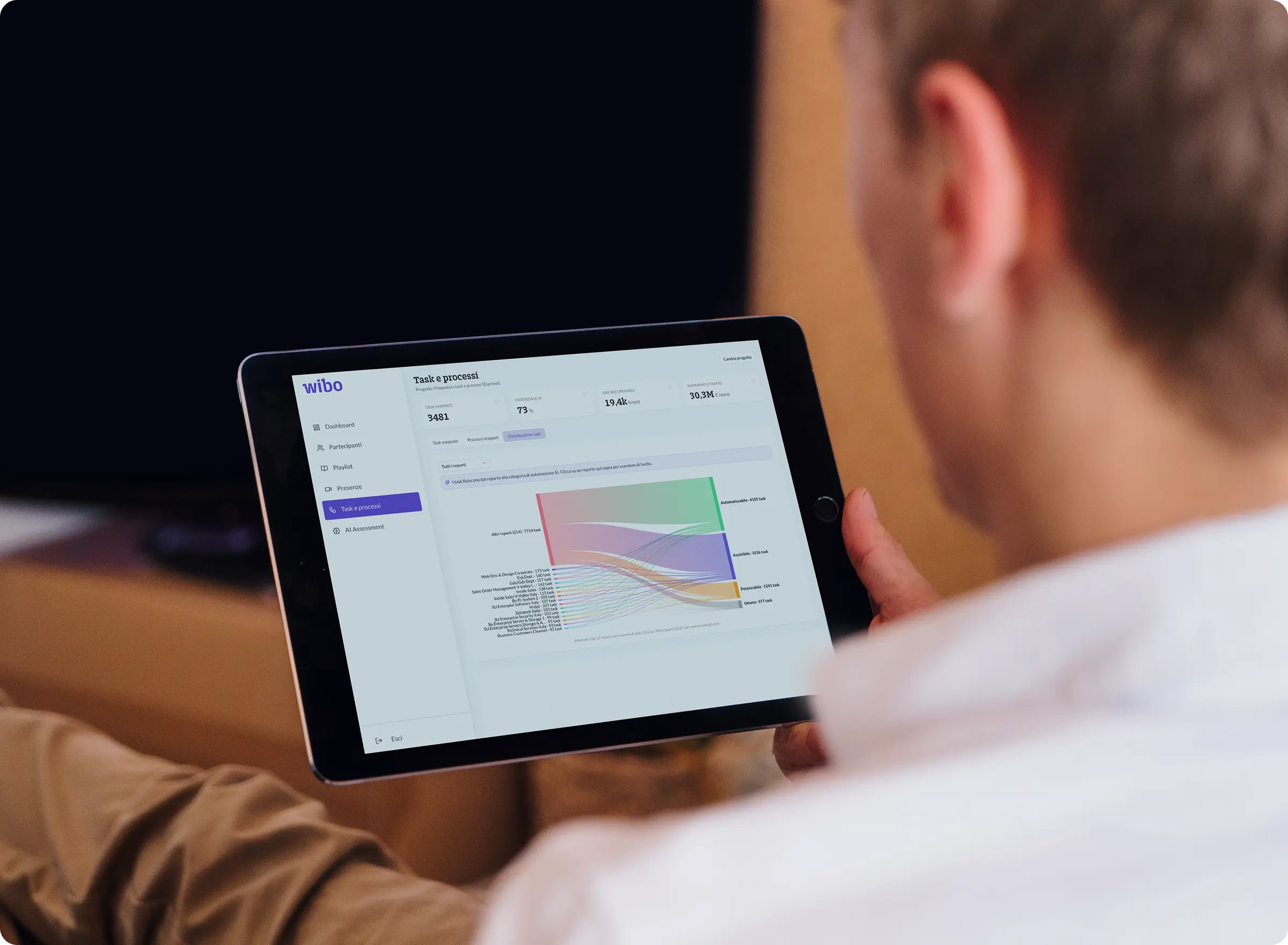
Person reviewing the Work Intelligence dashboard on a tablet

Make your organization smarter, starting from real work

Align leadership, HR, and IT on how to evolve people, processes, and AI together, with shared data and priorities.

Get in touch